http://www.quickmeme.com/p/3vzc9c
It always comes down to money. Programs don’t fund themselves!
In looking for funding resources for social media ethics, I explored what sorts
of programs there already were out there in the world that were being funded,
and the buzzword in education when it comes to social media and ethics is often
“digital citizenship.” It is a more broad term, and encompasses all sorts of
information literacy that does not necessarily fit my focus, but it showed me
where to look when it came to funding institutions and the types of programs
they were interested in funding. Here are three potential sources for funding,
and a few other free resources for instruction and curriculum that could save
money by taking the place of more costly resources in a program.
 The Andrew W. Mellon Foundation
The Mellon Foundation supports a broad range of
programs, but one would be particularly applicable to a Digital Citizenship or
Information Literacy program: Higher Education and Scholarship in the
Humanities. The Foundation has many subsections to this area, and they include
“Faculty growth as teachers, scholars, and academic citizens across the stages
of a professorial career,” and “Programs that scale up training for humanistic
engagement with the digital.” Both of these descriptors lead me to believe they
would be receptive to a grant proposal for a social media ethics program.
The Mellon Foundation accepts proposals all the time,
and they are presented to the Board of Trustees on a quarterly basis. They work
with applicants to revise and refine proposals before bringing them to the
board, so it’s best to leave plenty of time for that process. A grant from the Mellon Foundation could fund salary
and wages (or stipend) for a librarian to teach a course, the cost of equipment
and supplies for the program, marketing and advertising, and more.
The Moody
Foundation’s main goal is to “make a difference in the lives of the people of
Texas.” They fund a wide variety of
programs, granting funds to libraries, universities, and other organizations.
Some recent grants include $250,000 to the Galveston Rosenberg Library for
renovations, $150,000 to the University of Texas at Austin’s Blanton Museum of
Art for educational programs, and many more.
The Foundation
accepts proposals all the time, and meets for grant approvals quarterly. They
warn that the entire process may take up to 6 months, and to budget your time
for that. The funds that the Moody Foundation grants are general, and can be
used on teaching stipends, supplies, marketing, etc.
Texas State Library and Archives Commission
Through the Texas State Library and Archives
Commission, the current grant cycle is for fiscal year 2019, and the deadline
was March 8th, but the term will reset next year. Last year, awards
included $8,996 to Houston Public Library for promoting digital literacy, $10,000
for the University of North Texas to create webinars to promote digital literacy,
and more. Those examples fell under “Impact Grants,” and that seems like the
most likely route for a digital citizenship program. A TSLAC document describes
Impact Grants for Library Innovation and Improvement as being for a “new idea
for serving your community,” “implement[ing] a best practice that will improve
service delivery,” and “innovative notion[s] you want to test.” These awards
cannot exceed $10,000, and the funds do not require matching.
The award funds can cover staff, equipment, supplies,
and more, but are not to cover “building construction,” “food, beverages,” “awards,
honoraria, prizes, or gifts,” and any expenses that develop that are not
specifically for the program funded by the grant.
Basic information about “Digital Citizenship:”
Free educator resources:
Common Sense Media
InCtrl
Microsoft’s Digital Citizenship training

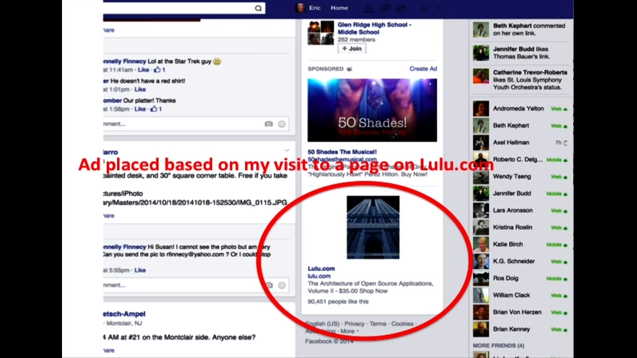 This video is a presentation from the Coalition for
Networked Information Fall 2014 Membership Meeting, held in Washington, D. C.
This recorded session is specifically about user privacy in libraries, and what
the major issues are in that area. Adobe Editions’ recording of user data is
referenced as a revelation for many people. Social media, and the Library 2.0
customization that is impending, is a major concern when it comes to privacy
and intellectual freedom. This presentation covers privacy and electronic
security in libraries overall, and is an excellent primer in the topic. Eric
Hellman focuses on social media and their potentially insidious intentions, and
how advertisements connect our browser history to our social media and beyond.
This video is a presentation from the Coalition for
Networked Information Fall 2014 Membership Meeting, held in Washington, D. C.
This recorded session is specifically about user privacy in libraries, and what
the major issues are in that area. Adobe Editions’ recording of user data is
referenced as a revelation for many people. Social media, and the Library 2.0
customization that is impending, is a major concern when it comes to privacy
and intellectual freedom. This presentation covers privacy and electronic
security in libraries overall, and is an excellent primer in the topic. Eric
Hellman focuses on social media and their potentially insidious intentions, and
how advertisements connect our browser history to our social media and beyond. The ethical implications of these problems is not as central
to the presentation as the technology involved, but it is there. Intellectual
freedom and the privacy-protecting mission of libraries is addressed, and with
some amount of ruefulness and concern. The presenters don’t just question the
intentions of social media companies and other internet entities, they name
them as infiltrators of our lives.
The ethical implications of these problems is not as central
to the presentation as the technology involved, but it is there. Intellectual
freedom and the privacy-protecting mission of libraries is addressed, and with
some amount of ruefulness and concern. The presenters don’t just question the
intentions of social media companies and other internet entities, they name
them as infiltrators of our lives. 


